Indonesia's Mountains Were Never Waiting to Be Discovered
Beyond Bromo, Ijen and Rinjani lies a far more varied mountaineering landscape. But why do certain mountains become internationally famous while others remain overlooked? And does every mountain need to be discovered?


Bromo, Ijen and Rinjani have become familiar symbols of Indonesia's mountain tourism. But beyond the established itineraries lies a far more varied mountaineering landscape — and a question about who gets to decide which mountains matter.
In 2025, more than 80,000 people went trekking in Gunung Rinjani National Park. Over half came from outside Indonesia. For a mountain rising above an island already celebrated for its beaches, waterfalls and cultural attractions, it is a remarkable level of international interest.
Elsewhere in Indonesia, climbers negotiate steep volcanic slopes, lengthy forest approaches, remote highlands and exposed ridgelines. Some of these mountains are familiar within Indonesian mountaineering circles but seldom feature prominently in international travel itineraries. It would be tempting to call them undiscovered, but that raises an obvious question: undiscovered by whom?
Many have established routes, local climbing communities and histories that existed long before international travellers began searching for their next adventure. Perhaps the more revealing question is not why so many Indonesian mountains remain relatively unfamiliar overseas, but why a handful of destinations have become so influential in defining how outsiders imagine the country's mountains — and whether international recognition tells us as much about a mountain as we assume.
The Mountains We Know How to Visit
For many international visitors, Indonesia's volcanic landscape begins with a familiar itinerary: Bromo at sunrise, Ijen's blue flames, and Rinjani's sweeping ridges and the crater lake of Segara Anak.
These are distinctly different experiences. Bromo is often experienced through an organised sightseeing excursion, with visitors travelling to viewpoints overlooking its volcanic landscape. Ijen attracts travellers interested in its unusual volcanic phenomena and sulphur-mining history. Rinjani demands considerably more physical commitment, with multi-day trekking routes traversing rugged terrain. Yet all three share an important characteristic: they are established tourism destinations.
Prospective visitors can find transport, accommodation, operators, itineraries and information that make the experience relatively straightforward to organise. This infrastructure matters. A mountain may possess extraordinary scenery or offer compelling climbing challenges, but without accessible information and practical arrangements, it can remain difficult for international travellers to consider.
Aam, founder of Raung Trip Indonesia, believes Rinjani's appeal extends beyond the mountain itself. Having worked in Indonesian mountain tourism since 2017, he points to Lombok's broader attractions — its beaches, waterfalls, food and culture — as part of what makes Rinjani such an appealing destination. The mountain offers a varied trekking experience within an island that already attracts international travellers.
His observation separates two qualities that are often treated as interchangeable. A mountain can be an extraordinary natural feature, and it can also be a highly successful tourism product. The first does not automatically produce the second. Transport connections, established businesses and international visibility can make a destination easier to discover and recommend. As more visitors arrive, the surrounding tourism ecosystem can develop further.
The relationship is not unique to mountaineering, but in the mountains it can shape something more consequential than holiday preferences: our understanding of which places are significant. When certain mountains repeatedly appear in itineraries, photographs and recommendations, their familiarity can begin to resemble a measure of importance. Other mountains may offer very different experiences without receiving comparable international attention. That does not make them inferior; it means the world beyond their established climbing communities may know less about them.
A mountain's international reputation, in other words, is not necessarily a ranking of its mountaineering significance.
Fame Does Not Make a Mountain Easy
Among experienced climbers, there can be a tendency to dismiss popular mountains as commercialised or insufficiently adventurous. The implication is that an established tourism industry somehow diminishes the challenge of the mountain itself. Rinjani offers a compelling reason to question that assumption.
In August 2025, Indonesia's Forestry Ministry identified Rinjani as Grade IV — difficult — under its national risk-based classification of trekking routes. The announcement followed a period of heightened scrutiny over climbing safety. Authorities introduced revised operating procedures, reviewed trekking routes and strengthened safety infrastructure. The mountain had become an established international destination, but its hazards had not disappeared.
There is a difference between making an expedition easier to organise and making a mountain easier to climb. Guides, porters, transport and established routes can reduce logistical uncertainty, but they cannot eliminate fatigue, steep terrain, adverse weather or the consequences of inadequate preparation. Aam identifies insufficient physical preparation and unsuitable equipment as recurring problems among climbers he encounters.
“Regardless of a mountain's height, proper preparation is always essential.”
Aam, founder of Raung Trip Indonesia (translated from Indonesian)
Yet the opposite assumption is equally flawed. A mountain does not become more challenging or meaningful simply because it attracts fewer visitors. A remote route may involve relatively straightforward terrain, while a heavily visited mountain can present serious physical and environmental hazards. Nor does technical difficulty determine the value of an experience.
For someone attempting their first major mountain expedition, completing Rinjani may represent a profound personal achievement. For another climber, an unfamiliar route involving greater exposure may offer a different kind of challenge. Neither experience requires the other to be diminished. The relevant question is not whether a mountain is popular, but what it actually demands of those who climb it.
Obscurity is not a mountaineering qualification.
The Indonesia Beyond the Itinerary
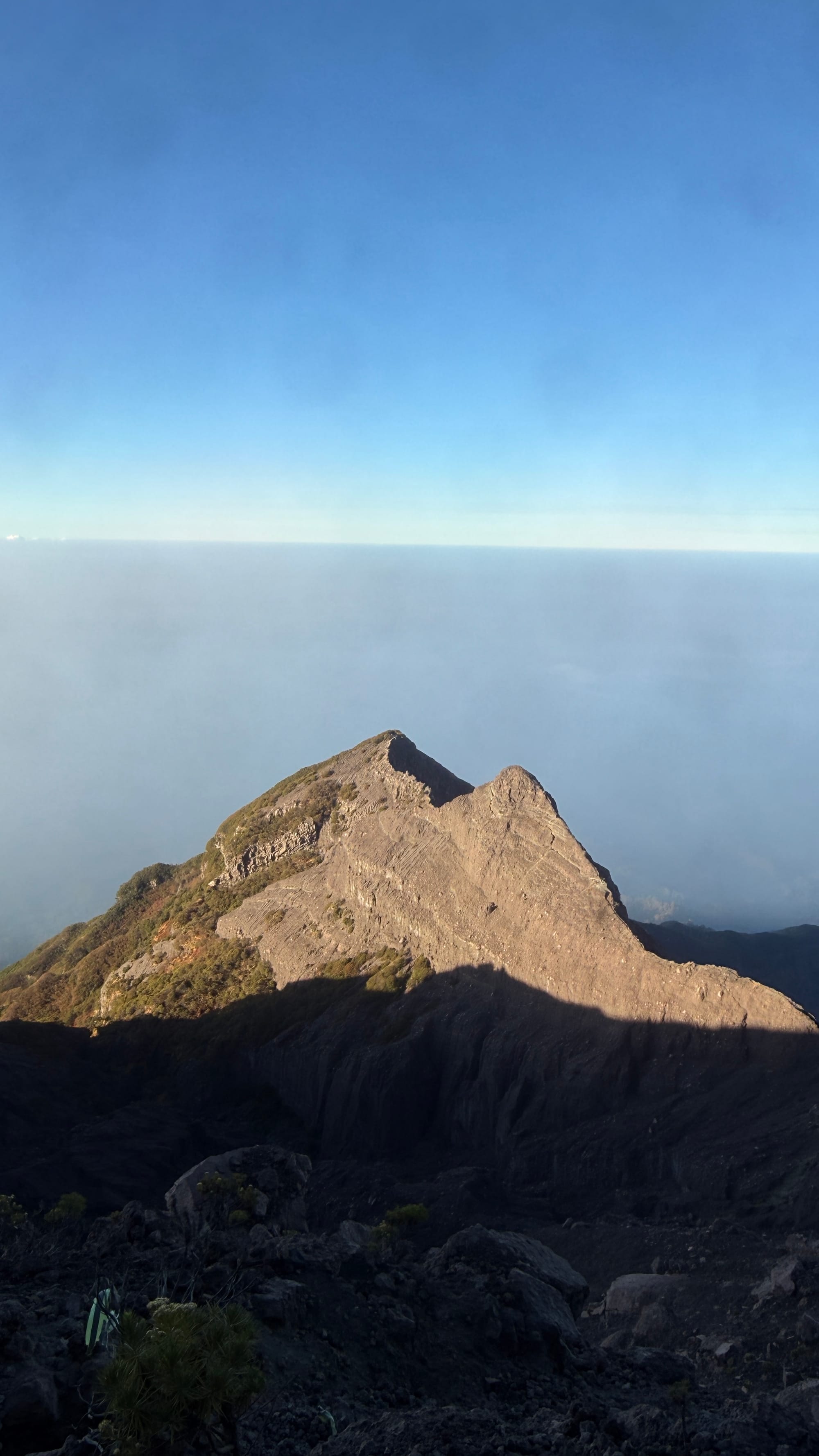
Even within Java, Indonesia's mountaineering landscape resists easy generalisation.
Semeru, the island's highest mountain at approximately 3,676 metres, rises through a landscape shaped by volcanic activity. Its forested approaches and upper volcanic terrain present very different environments within the same mountain. Slamet offers another kind of challenge. Routes such as Bambangan involve sustained ascent and substantial elevation gain, demanding endurance across changing terrain.
Raung's Kalibaru route is different again. Its approach leads towards exposed ridgelines and sections requiring rope-assisted movement on the way to Puncak Sejati. Here, the challenges extend beyond stamina to movement on steep, exposed terrain. These mountains are not interchangeable objectives, nor are they simply progressively harder versions of the same experience. They illustrate how much variety can exist within one island.
Aam makes similar distinctions in his work. He considers Merbabu a suitable introduction for many newer hikers, describes Rinjani as a varied and demanding trek, and identifies Raung as an objective involving greater exposure and technical challenges. These are his assessments, not universal difficulty rankings. The demands of any climb depend on its route, prevailing conditions and the experience of those attempting it.
Beyond Java, the diversity becomes greater still. Sumatra is home to Kerinci and the mountain landscapes of the Bukit Barisan range. Sulawesi offers distinct highland environments, while Papua introduces different questions of altitude, remoteness, access and technical mountaineering. To describe all of these as alternatives to Rinjani would miss what makes them different. Indonesia is not a single mountaineering destination, but an archipelago containing numerous mountain environments shaped by different geographical, environmental and cultural circumstances.
There is another distinction that deserves attention. Mountains relatively unfamiliar to international travellers may already be well known to Indonesian climbers. Their routes may be established, their landscapes may hold cultural or historical importance, and their surrounding communities may have relationships with them that extend far beyond recreational climbing.
Calling such places undiscovered risks placing the outsider at the centre of their story. It suggests that a mountain becomes significant when someone from elsewhere learns of its existence, yet the mountain was there before the visitor arrived. So were the people who knew it.
When we describe a place as hidden or undiscovered, are we describing the mountain, or revealing the limits of our own knowledge?
When the Tourist Trail Becomes a Starting Point
There is an appealing argument that commercial tourism narrows our experience of mountains. But it may also create opportunities for people to discover mountaineering in the first place.
Aam has noticed this among some of his Malaysian and Singaporean customers. Many begin with familiar objectives such as Rinjani or Merbabu. After completing those expeditions, some develop an interest in mountains such as Raung, Argopuro and Arjuno. This is an observation about his customers, not evidence of a nationwide trend, but it complicates the idea that established tourism circuits necessarily restrict adventure.
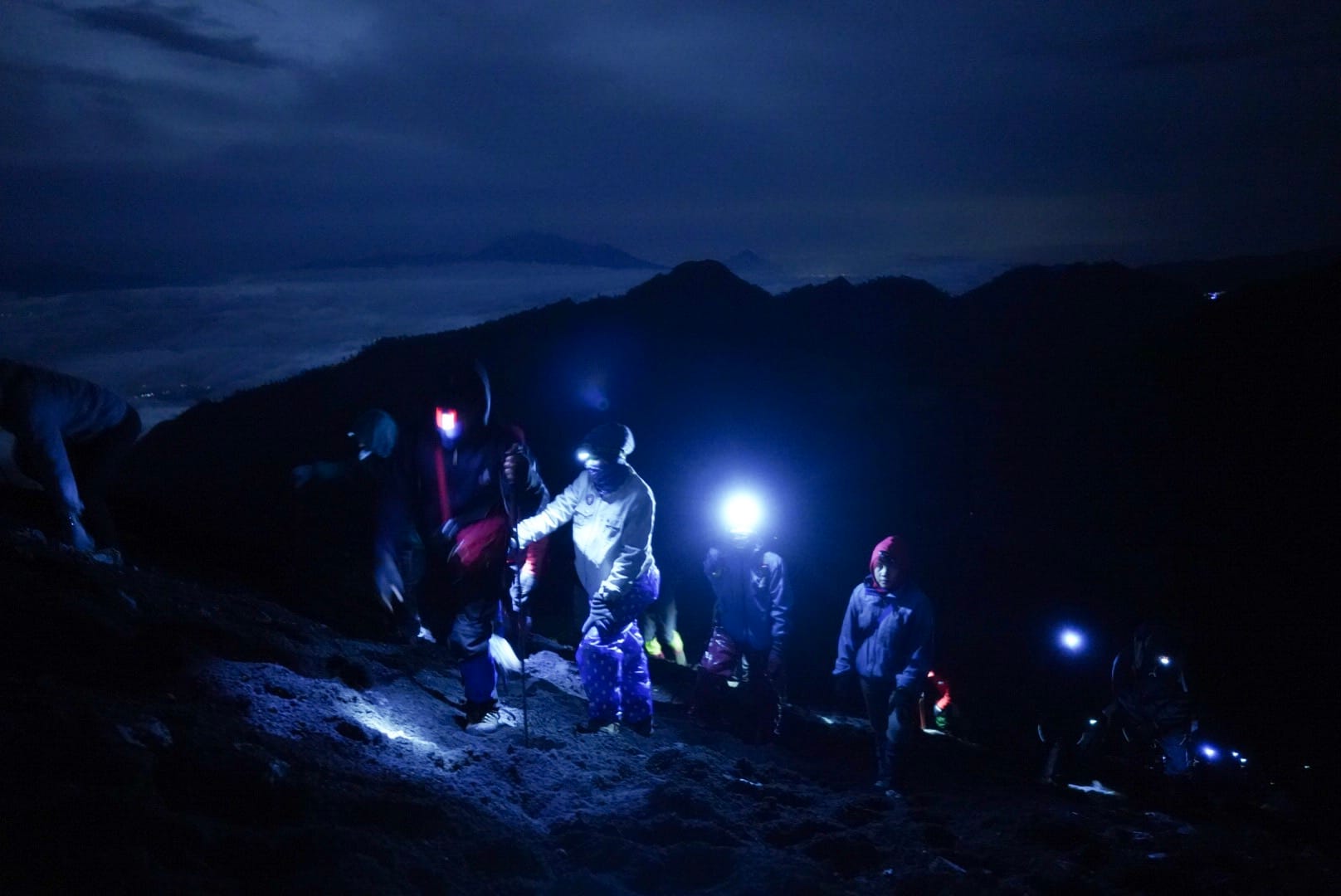
A guided expedition may introduce someone to sustained climbing, unfamiliar terrain and the physical demands of mountain travel. For some, the experience becomes the beginning of a much wider interest. The same infrastructure that draws international attention towards a small number of familiar destinations may therefore help introduce climbers to mountains beyond them.
That does not mean every trekker must eventually seek more difficult objectives. Rinjani is not merely a stepping stone towards something supposedly more authentic, nor is a technical ascent inherently more meaningful than a popular trekking route. Mountaineering is not a hierarchy in which danger and obscurity automatically confer greater value.
An established destination can nevertheless create curiosity about what lies elsewhere. For some climbers, the familiar tourism circuit is not the boundary of their experience but the entrance. And that creates a more complicated question: if international interest in less familiar mountains grows, should those mountains be developed to accommodate it?
Does Every Mountain Need to Become Famous?
In 2025, Gunung Rinjani National Park recorded approximately 30.36 tonnes of waste associated with trekking activity. The figure represents waste recorded in the park's management data and should not be interpreted as an amount abandoned on the mountain. Nevertheless, it illustrates the scale of waste management associated with a major trekking destination.
The challenges of managing visitor numbers extend beyond litter. Mountain authorities must consider route conditions, emergency preparedness, environmental protection and the capacity of infrastructure to support recreational activity. In April 2025, these competing pressures were visible in discussions over Rinjani's trekking quotas.
Tourism operators and surrounding communities raised concerns about visitor limits and their effects on local livelihoods. West Nusa Tenggara officials discussed evaluating the quotas alongside infrastructure, accessibility and tourism development. The debate reflected a difficult balance: tourism creates economic opportunities, but the ability to attract visitors is not the same as the capacity to accommodate unlimited numbers of them.
Aam's own career illustrates what those opportunities can mean. He began working as a porter in 2017 while attending university, using the income to help support his living expenses and education. He later became a guide and established Raung Trip Indonesia in early 2023. His experience is a reminder that mountain tourism is not simply recreation for visitors. It can also provide livelihoods for people working in and around mountain communities.
Greater international interest may create opportunities for guides, porters, accommodation providers and transport businesses, but more visitors do not automatically produce better outcomes. In August 2026, Indonesia's Forestry Ministry announced risk-based restrictions on trekking in protected mountain areas amid heightened forest-fire concerns. Semeru was among the areas designated for temporary trekking closure, while Rinjani, Merbabu and Argopuro were designated for limited access under stricter supervision.
The measures illustrated something easily overlooked when mountains are presented primarily as tourism destinations: access is conditional. A mountain is also an environment subject to conservation needs, natural hazards and management decisions that may not align with visitors' expectations. Greater demand cannot be the only consideration, nor should the commercial success of one destination automatically become the model for every other mountain.
Some areas may be capable of supporting carefully managed tourism growth. Others may have ecological, cultural or practical constraints that make extensive development inappropriate. And some mountains may be important for reasons that have little to do with recreational access.
This raises a question that rarely appears in articles celebrating undiscovered destinations: if a mountain becomes internationally famous, who benefits?
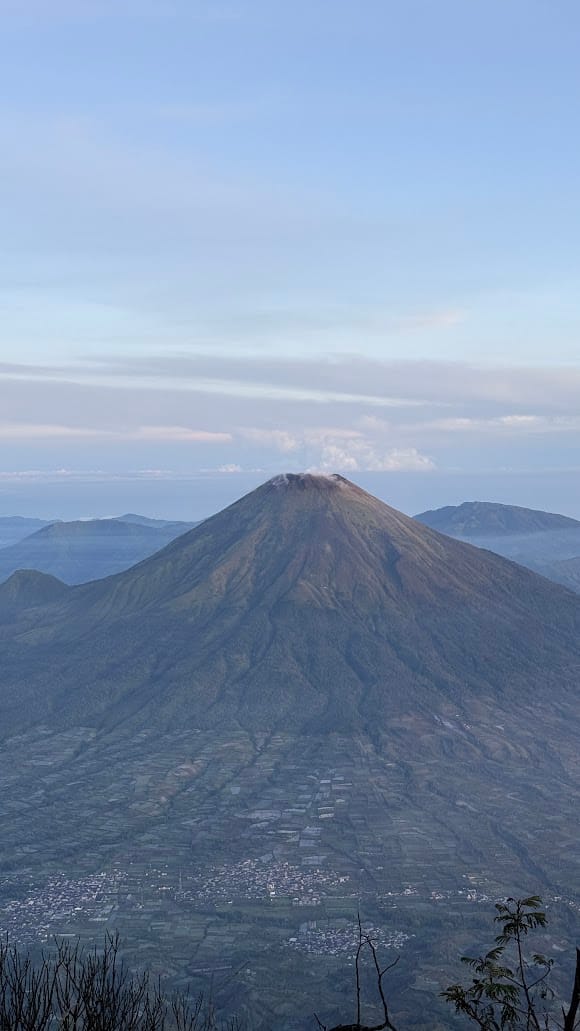
Visitors gain another experience, businesses organise the expeditions, and guides and porters may find new employment opportunities. Surrounding communities may benefit economically, but they may also bear costs associated with greater visitation. These interests can overlap without necessarily being identical.
Greater recognition may bring economic opportunities while creating pressures that a mountain's environment, infrastructure or surrounding communities are poorly equipped to absorb. The question should not simply be how to turn another Indonesian mountain into the next Rinjani. It should be whether that is desirable, for whom, and under what conditions.
Beyond Recognition
Bromo, Ijen and Rinjani are remarkable places. Their popularity does not diminish their beauty, their significance or the experiences they offer. Established tourism has also made Indonesian mountain landscapes accessible to people who might otherwise never have considered visiting them.
But the familiar itinerary is not the whole story. Beyond it lies a far more varied mountaineering landscape, with different terrain, different challenges and different relationships between people and mountains. Some of these places may attract greater international attention in the future, while others may remain primarily familiar to Indonesian climbers and the communities around them. Neither outcome automatically determines their worth.
Perhaps the more important question is not why certain Indonesian mountains have yet to become internationally famous, but why international fame so often becomes our measure of whether a mountain matters.
Indonesia's mountains were never waiting for outsiders to discover them. It is our understanding of them that remains incomplete.
Sources & Reporting Notes
This article draws on original interview correspondence with Aam, founder of Raung Trip Indonesia, and publicly available information from Indonesian government agencies and national-park authorities.
Primary sources
- Gunung Rinjani National Park — Rinjani in Numbers 2025. Trekking visitation and waste-management statistics, published January 2026.
- Indonesian Forestry Ministry — Rinjani Trekking Safety and Route Grading. Government announcement, August 2025.
- West Nusa Tenggara Provincial Government — Rinjani Trekking Quota Review. Provincial government announcement, April 2025.
- Gunung Rinjani National Park — Tourism Operators and Community Concerns. National-park account of the April 2025 discussions.
- Indonesian Forestry Ministry — Risk-Based Mountain Access Restrictions. Government announcement, August 2026.
Additional geographical references
- Indonesia's Ministry of Tourism — Mount Semeru.
- Muncak — Slamet via Bambangan Route Profile.
- Gunung Indonesia — Mount Raung Routes.
Original reporting
Interview correspondence with Aam, founder of Raung Trip Indonesia, conducted for The Mountain Narrative, 2026. His comments have been paraphrased in English for clarity.